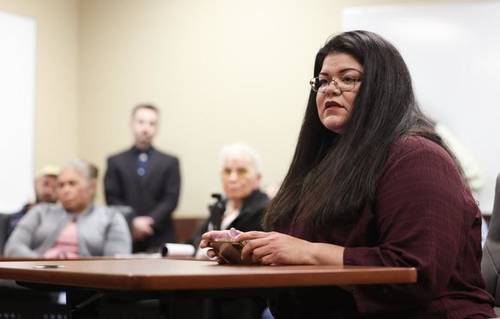
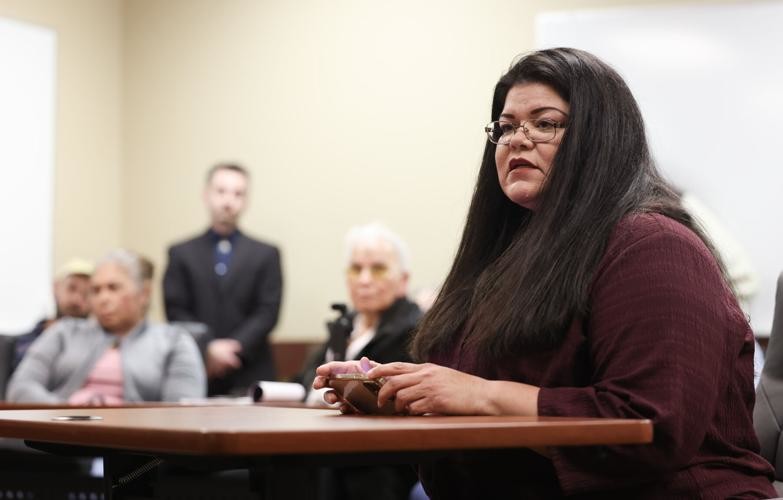
Dozens of Lower Valley residents crammed into the Yakima Regional Clean Air Agency’s office on Wednesday night, urging decision makers to hit the brakes on a project that could become one of the largest manure biodigesters in the country.
For nearly three hours, community members shared concerns about safety, pollution risks and transparency.
Pacific Ag Renewables, an Oregon-based company, wants to build a biomethane plant at the Port of Sunnyside Industrial Park off Sunnyside Mabton Road. The 50-acre project would partner with local dairy farmers to repurpose manure, putting it through a series of anaerobic digesters to produce methane. That methane would then be used to create renewable natural gas, and some of the biproducts would be used to create fertilizer.
The project is expected to generate enough energy to power 90,000 homes.
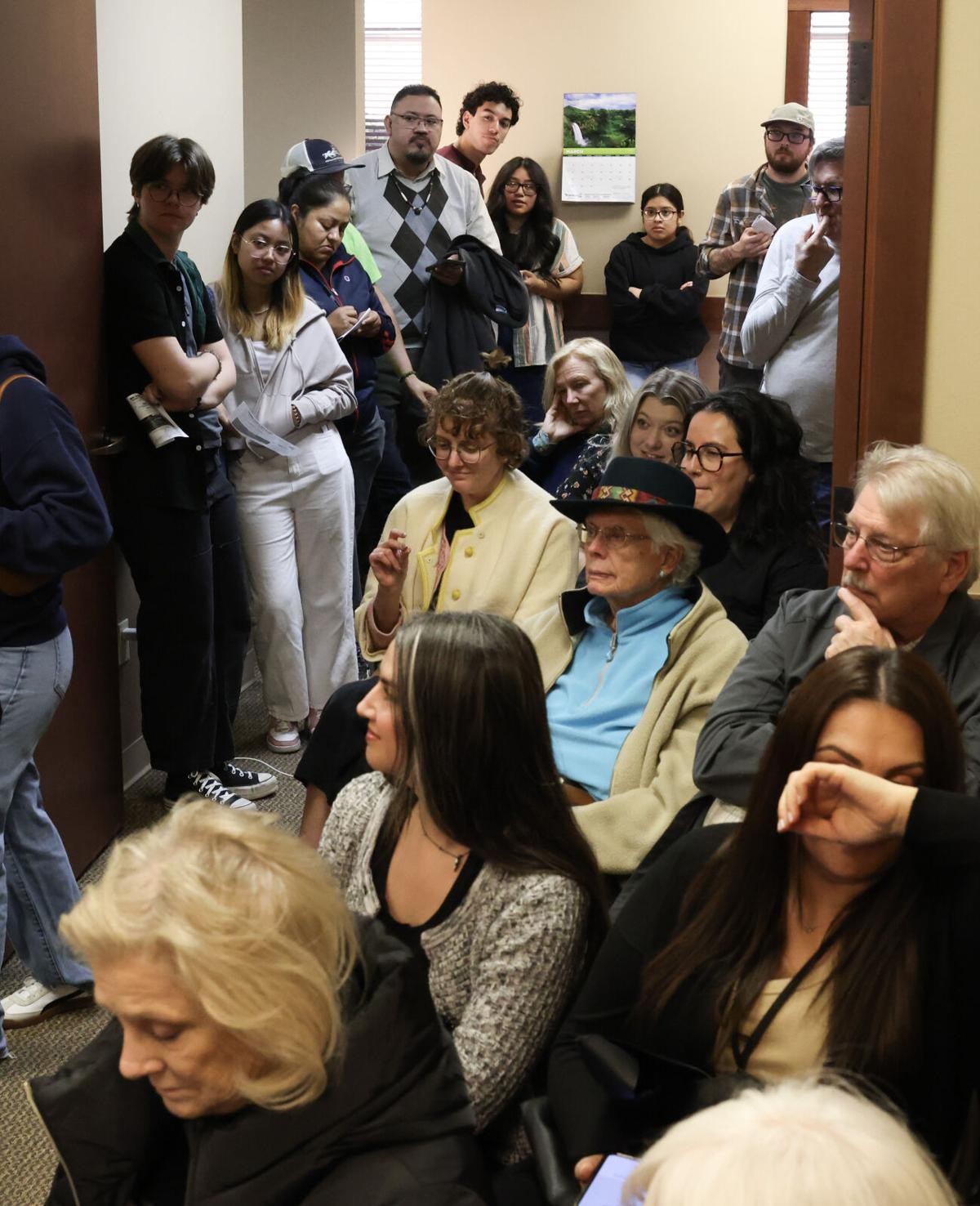
People watch and listen to a public hearing concerning a proposed biomethane plant in Sunnyside from the hallway TUesday, March 25, 2026, at Yakima Regional Clean Air Agency office in Yakima, Wash. Evan Abell / Yakima Herald-Republic
Receiving an air permit from the Yakima Regional Clean Air Agency — the topic of Wednesday’s public hearing — would be a key step in moving the project forward. Leaders from Pacific Ag Renewables say the goal is to develop a world-class facility that supports agriculture, environmental stewardship and local economic growth, but residents say they’ve been left out of the conversation.
Project history and timeline
Pacific Ag Renewables first began exploring plans for a biodigester in Sunnyside a few years ago. Although there are larger biodigesters operating in Europe, Project Manager Kipp Curtis said the proposed project would be one of the larger facilities in the United States.
In 2022, the city of Sunnyside approved an agreement with the company and the Port of Sunnyside to establish a 200-acre industrial park. The city and the port invested $12 million in infrastructure like sewer pipelines, water mains and a roadway to make the site accessible for industrial development and clear the way for the project.
Sunnyside Building Official Cory Taylor said the city has yet to receive any building permit submittals for the biodigester. Pacific Ag Renewables has completed the Washington State Environmental Policy Act process.
The process starts with an environmental checklist, where a project applicant answers questions about potential environmental impacts of a project. Other parties, like the state Department of Ecology and the state Department of Transportation, also review the proposal and provide comments. Then, the lead agency — in this case, the city of Sunnyside — reviews the checklist and makes a determination about whether the proposal is likely to have a significant adverse environmental impact. If it is, an environmental impact statement is required.
The city of Sunnyside has issued two "mitigated determinations of non-significance" for the proposal, meaning more detailed environmental review isn't needed. Those determinations concluded that it’s unlikely the project would have significant adverse environmental impacts, and included steps for addressing traffic impacts, stormwater discharge and other concerns.
The first determination, which came out in 2023, was appealed by Friends of Toppenish Creek, a Lower Yakima Valley environmental group that has expressed concerns about the thoroughness of the environmental review. After canceling the appeal, the city reopened the process to allow for additional comments, finalizing its second determination of non-significance in 2024.
Now, approval for an air permit could move the project one step closer to reality.
The Yakima Regional Clean Air Agency has already made a preliminary recommendation to issue an order of approval for the project, but a final decision won’t be made until after the public comment period ends on March 30. An air permit is just one of the permits that would be required to begin construction.
The Yakima Regional Clean Air Agency approval "is a key step in the air permitting process,” Curtis told the Yakima Herald-Republic in an email. “It allows the project to move forward toward construction while advancing our goals of reducing greenhouse gas emissions and supporting Washington’s agricultural economy.”
Resident concerns
The Sunnyside biodigester facility is expected to create around 30 jobs and generate around $2 million annually in employee payroll. According to Pacific Ag’s estimates, it’s also expected to reduce carbon emissions on a level equivalent to taking 40,000 cars off the road.
Yakima County Commissioner LaDon Linde said during public comment he sees it as a win-win for the community.
Linde shared his experience visiting a similar facility in Tillamook, Oregon, where he noticed very little odor and heard no complaints from neighbors. If anything, he said, he believes the system could offer a solution to waste management and odors in Sunnyside by offering a single, contained facility for people to bring their manure.
But Linde was far outnumbered by opponents.
Maria Fernandez, executive director of Empowering Latina Leadership and Action, or ELLA, said the project has “way too many unknowns.” She pointed to instances of biodigesters exploding or leaking, including an anaerobic digester at the Port of Tillamook that malfunctioned in 2019, causing more than 100,000 gallons of partially treated cow manure to overflow into a nearby creek.
Fernandez was one of many on Wednesday night to demand a thorough environmental impact statement before any further action is taken on the project.
“Our communities have the right to clear, transparent information about potential environmental and public health consequences,” she said.
Residents shared a host of concerns, including the proximity of the proposed facility to homes, businesses, a child care provider and an assisted living facility. Several speakers said they lived just a mile or two from the proposed site.
Others highlighted the potential impacts of trucks coming and going from the facility. Some residents referenced the potential for 140 trucks on the road per day, questioning who would be responsible for paying for road repairs, how the trucks would affect traffic and how emissions could elevate air pollution. Curtis said the facility is expected to have anywhere from 90 to 115 trucks entering and exiting per day, and traffic studies indicate minimal traffic impacts.
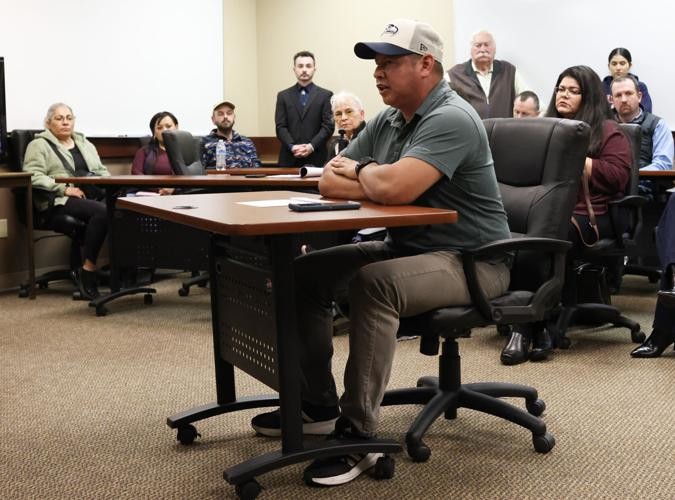
Juan Alvarez, a former Sunnyside water distribution specialist, echoed concerns about potential air and water contamination.
Juan Alvarez speaks during a public hearing concerning a proposed biomethane plant in Sunnyside Tuesday, March 25, 2026, at Yakima Regional Clean Air Agency office in Yakima, Wash.
Evan Abell / Yakima Herald-Republic
While manure biodigesters are used to create natural gas, they also create a liquid waste byproduct called digest. The proposed facility is a closed system, which means that hypothetically none of the compounds being produced should escape into the atmosphere or the soil. However, Alvarez said if that system has a failure and the digest leaks or leaches into the groundwater, it could raise serious public health concerns.
“As a former water system specialist for the city of Sunnyside and a steward of the Safe Water Drinking Act, I feel that the impact of this facility is not what our community needs,” Alvarez said. “Our community deserves better than being an afterthought in a project of this scale.”
Transparency
Sunnyside is already part of an "overburdened community" that is highly impacted by air pollution, according to the state Department of Ecology. A recent report from the agency found the Lower Yakima Valley has among the highest age-adjusted annual death rates in the state associated with fine particle pollution.
In Kingsly McConnell’s eyes, approving an air permit for the project would be “rubber stamping a textbook case of environmental injustice.”
McConnell is a staff attorney at the Center for Food Safety working alongside community groups in the Lower Yakima Valley. He said he believes the data used to support the Yakima Regional Clean Air Agency's draft order of approval is outdated and significantly underestimates ambient air quality in Sunnyside. According to the draft, air emissions from the project are expected to include air pollutants, greenhouse gases and volatile organic compounds, but the project doesn’t rise to a level that would push air quality beyond regulatory thresholds.
Projects that exceed those standards are required to obtain something called a Title V air permit from the EPA.
“Air emissions from this facility will push that criteria pollutant over the legal limit,” McConnell said, referring to particulate matter. “And frankly, it is incredulous to believe that this facility does not require a Title V permit.”
McConnell also highlighted another key concern repeated by residents throughout the hearing: transparency.
Sunnyside Mayor Vicky Frausto said she had gone door to door in 2023 to ask residents in proximity to the proposed biodigester site if they were aware of the plans.
“Not one resident knew about this project. Most were monolingual Spanish speakers,” Frausto said, speaking in an individual capacity and not on behalf of the Sunnyside City Council. “That is not transparency, that is systemic exclusion rooted in a pattern where communities of color are left out of decision making while they are expected to absorb the harm.”
Frausto and others also noted that they had seen few if any materials about the project in Spanish.
Lorena Avalos, a Sunnyside resident who lives about a mile and a half from the industrial park, said she was supposedly informed about the project two years ago, but all of the information was in English. Had she known what was going on, she would have spoken up against it.
"Por favor, escúchenos y no nos ignoren," Avalos said. “Please listen to us and don’t ignore us.”
Curtis said transparency is Pacific Ag’s goal, too.
The company has participated in around five meetings with groups in Sunnyside to try to get more information out. Pacific Ag also had a booth at Sunnyside’s Cinco de Mayo parade, where it handed out flyers in both Spanish and English. The company’s website is also available in both English and Spanish, and people with questions can reach out to [email protected].
The company has been working within all of the required regulatory boundaries to move forward with the project, Curtis added.
“I myself am here a lot, and am open to meeting anybody, anywhere, to give more information and answer questions,” he said. “We truly want to be transparent in the process that's going on and answer the questions.”
Maricela Santana-Walle, ELLA’s environmental justice coordinator, said the community expects more.
“Five meetings in five years is completely disappointing, and you should not be waiting for the community to invite you,” she said.
Links to the Yakima Regional Clean Air Agency's draft order of approval and supporting documents can be found online at www.yakimacleanair.org/notices.
Olivia Palmer can be reached at [email protected].

Olivia Palmer / Staff Writer